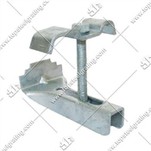
Hot-dip galvanizing of steel grating, also known as hot-dip galvanizing, is to melt the zinc ingot at high temperature, put some auxiliary materials, and then immerse the steel grating member into the galvanizing tank, so that the steel grating member is attached with a layer of zinc.
The advantages of hot-dip galvanizing lie in its strong anti-corrosion ability and good adhesion and hardness of the galvanized layer. The weight of steel grating products increases after galvanizing, which is often referred to as the amount of zinc.
The formation of hot-dip galvanized layer The process of forming the hot-dip galvanized zinc layer is the process of forming an iron-zinc alloy between the iron matrix and the outermost pure zinc layer. The iron-zinc alloy layer is formed on the surface of the workpiece during hot-dip plating, so that the iron Good bond with pure zinc layer. When the iron workpiece is immersed in molten zinc, a solid solution of zinc and α iron (body-centered) is first formed at the interface. This is a crystal formed by dissolving zinc atoms in the base metal iron in a solid state. The two metal atoms are fused, and the gravitational force between the atoms is relatively small. Therefore, when zinc reaches saturation in the solid solution, the atoms of the two elements, zinc and iron, diffuse into each other, and the zinc atoms diffused into the iron matrix migrate in the matrix lattice, gradually form alloys with iron, and diffuse into the molten zinc solution. The iron in the iron and the zinc form the intermetallic compound FeZn13, which sinks into the bottom of the hot-dip galvanizing pot, which is the zinc slag. When the workpiece is removed from the zinc immersion solution, a pure zinc layer is formed on the surface, which is a hexagonal crystal.
https://www.topsteelgrating.com/