

What is the Coefficient of Thermal Expansion of Heavy Duty Bar Grating?
As a supplier of heavy duty bar grating, I often receive inquiries from clients about various technical aspects of our products. One question that comes up quite frequently is about the coefficient of thermal expansion of heavy duty bar grating. Understanding this property is crucial for proper installation, long - term performance, and ensuring the safety and functionality of the grating in different environments.
Understanding the Coefficient of Thermal Expansion
The coefficient of thermal expansion (CTE) is a measure of how much a material expands or contracts in response to a change in temperature. It is defined as the fractional change in length or volume per unit change in temperature. For linear expansion, the coefficient of linear thermal expansion ($\alpha$) is used, and it is expressed in units of per degree Celsius ($^{\circ}C^{-1}$) or per degree Fahrenheit ($^{\circ}F^{-1}$).
Mathematically, the change in length ($\Delta L$) of a material due to a temperature change ($\Delta T$) can be calculated using the formula: $\Delta L = L_0\times\alpha\times\Delta T$, where $L_0$ is the original length of the material.
Factors Affecting the CTE of Heavy Duty Bar Grating
The CTE of heavy duty bar grating is primarily influenced by the material from which it is made. Most heavy duty bar gratings are made from steel, which has a relatively well - defined coefficient of thermal expansion.
- Material Composition:
- Steel is an alloy, and the exact composition of the steel used in bar grating can affect its CTE. For example, carbon steel, which is commonly used in heavy duty bar grating, has a coefficient of linear thermal expansion of approximately $12\times10^{-6}\ ^{\circ}C^{-1}$ or $6.7\times10^{-6}\ ^{\circ}F^{-1}$. However, if the steel contains other alloying elements such as nickel, chromium, or manganese, the CTE can vary. Stainless steel, which contains significant amounts of chromium and nickel, has a slightly higher CTE compared to carbon steel, typically around $16\times10^{-6}\ ^{\circ}C^{-1}$ or $8.9\times10^{-6}\ ^{\circ}F^{-1}$.
- Manufacturing Process:
- The manufacturing process of the bar grating can also have an impact on its CTE. For instance, if the bars are cold - worked during the manufacturing process, the internal stresses in the material can affect its expansion behavior. Heat treatment processes, such as annealing, can relieve these internal stresses and make the CTE more consistent and closer to the theoretical value of the base material.
Importance of CTE in Heavy Duty Bar Grating Applications
- Installation:
- When installing heavy duty bar grating, it is essential to account for the thermal expansion. If the grating is installed in a way that restricts its expansion, it can lead to buckling, warping, or damage to the grating and the supporting structure. For example, in large - scale industrial flooring applications, expansion joints should be incorporated at appropriate intervals to allow for the thermal expansion of the grating.
- Long - Term Performance:
- Over time, the repeated expansion and contraction of the bar grating due to temperature changes can cause fatigue and wear. Understanding the CTE helps in predicting the long - term performance of the grating and ensuring that it can withstand the environmental conditions without significant degradation.
- Safety:
- In some applications, such as in walkways or platforms, the movement of the bar grating due to thermal expansion can pose a safety hazard. If the grating is not properly installed or designed to accommodate thermal expansion, it can create uneven surfaces or gaps, increasing the risk of tripping or falling.
Different Types of Heavy Duty Bar Grating and Their CTE
- Composite Steel Bar Grating:
Composite steel bar grating combines the strength of steel bars with other materials, such as fiberglass or plastic. The CTE of composite steel bar grating depends on the CTE of both the steel bars and the additional material. The steel bars will expand and contract according to the CTE of steel, while the other material may have a different CTE. This can lead to differential expansion, which needs to be considered during design and installation. You can learn more about Composite Steel Bar Grating. - Serrated Press - Locked Steel Grating:
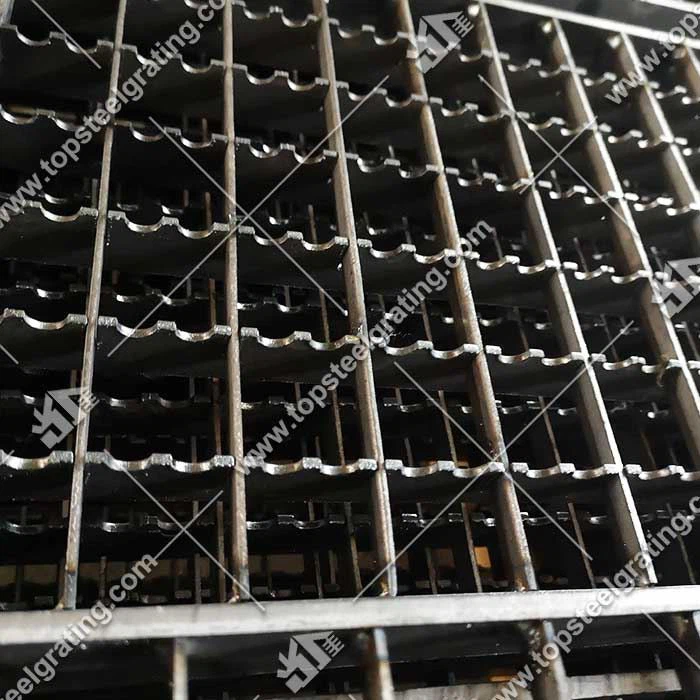
Serrated press - locked steel grating is made by pressing serrated steel bars together to form a strong and slip - resistant surface. Since it is made of steel, its CTE is similar to that of regular steel bar grating. However, the serrated design may introduce some additional factors that can affect the overall expansion behavior, such as the stress concentration at the serrations. You can find more details about Serrated Press - Locked Steel Grating. - Serrated Metal Grating:
Serrated metal grating can be made from various metals, including steel and aluminum. Aluminum has a higher CTE compared to steel, approximately $23\times10^{-6}\ ^{\circ}C^{-1}$ or $12.8\times10^{-6}\ ^{\circ}F^{-1}$. So, if the serrated metal grating is made of aluminum, it will expand and contract more than a steel - based grating for the same temperature change. You can explore Serrated Metal Grating for more information.
Measuring the CTE of Heavy Duty Bar Grating
Measuring the CTE of heavy duty bar grating can be done using specialized equipment. One common method is the dilatometer, which measures the change in length of a sample as the temperature is varied. The sample is placed in the dilatometer, and the temperature is gradually increased or decreased while the change in length is recorded. The CTE can then be calculated from the measured data.

However, in most cases, the CTE values provided by the material suppliers are used for design and installation purposes. These values are based on extensive testing and are considered reliable for practical applications.
Conclusion
The coefficient of thermal expansion is an important property of heavy duty bar grating that affects its installation, long - term performance, and safety. As a supplier, we understand the significance of this property and ensure that our products are designed and manufactured to perform well under different temperature conditions.
If you are in need of heavy duty bar grating for your project, it is crucial to consider the CTE and its implications. Our team of experts can provide you with detailed information and guidance on selecting the right type of bar grating for your specific application. We are committed to providing high - quality products and excellent customer service. Contact us to discuss your requirements and start a procurement negotiation.


